
Deburring cell for burr-free components and short cycle times
Burrs cause assembly errors, lead to injuries, and increase costs due to rework. In many production processes, rework increases by up to 30%. At gKteso, we combine robots, clamping technology, tools, and measurement technology in an automated deburring cell. This ensures smooth edges, short cycle times, and verified quality in every series.

Deburring cell: More than a necessity
Burrs reduce fit accuracy and damage surfaces. They increase scrap and cause components to jam during assembly or fail after a short time. In the automotive, aerospace, and mechanical engineering industries, these problems, for example, lead to production stops, complaints, and additional costs.
The deburring cell for series production from gKteso closes this gap in the process. Robots, clamping technology, tools, and sensors work together precisely. Each component is firmly fixed in the cell, the system deburrs all relevant areas, and quality control documents the result. This ensures reproducible results in every series, reduces your process costs, and protects your operations from unplanned downtimes.
Features of the gKteso deburring cell
Working area for versatile components
The cell offers a working area of 500 x 500 x 300 millimeters. This allows you to process small precision parts as well as larger cast parts.
High repeat accuracy
With an accuracy of 0.05 millimeters, the cell deburrs even complex geometries without deviation. This significantly reduces rework.
Flexible workstations
Up to 16 stations enable combined processes such as milling, grinding, brushing, marking, and backside machining. Several work steps are thus carried out in a single operation.
Parallel processes
With a changeover table or rotary table, loading, processing, and removal occur simultaneously. This shortens the cycle times and increases output per shift.
Integrated quality control
Laser scanners and measuring probes examine each workpiece directly after processing. Faulty parts do not even enter the assembly.
Modular design
The cell can be adapted to changing components and series sizes. It grows with your requirements and remains usable long-term.
Functionality of the deburring cell
The deburring cell secures the component, detects contours, and guides the appropriate tools along the edges. Milling, grinding, brushing, and optional additional steps like backside machining, marking, or sandblasting can be combined. Sensors check the edges immediately afterward, and the control system logs all results.
- The process begins with the feeding of the component, which is placed manually by employees or automatically by a system, and the clamping technology then secures it.
- Sensors capture the geometry and, based on this, calculate the exact processing paths for the robot.
- The robot selects the appropriate tool and guides it along all relevant edges, holes, and internal contours.
- Additional steps such as backside machining, marking, or sandblasting can be combined in the same setup.
- Finally, scanners and probes inspect the processed edges, record the measurement data, and release the finished part to the next station.

Applicability of the deburring cell
The deburring cell can be flexibly adapted to different components and materials.
It is suitable for:
- Metal processing: Aluminum, steel, and cast iron with stable edges for assembly and function.
- Plastic processing: Injection molded parts with clean edges for seals and visible surfaces.
- Milled parts: Even edge progressions for exact fits and trouble-free assembly.
- Punched parts: External edges and holes with smooth edges for subsequent processing steps.
- Die-cast parts: Complex geometries with smooth edges for consistent quality in series.
Advantages for your production
-
Reproducible edge quality
Every part leaves the cell with a clean, verified edge. This reduces scrap and ensures consistent results in every series. -
Shorter cycles and more output
Parallel processes with a changeover table or rotary table shorten secondary times. This increases output without additional lines. -
Quick retooling for variants
The modular structure and stored programs dramatically reduce setup times. This keeps your production productive even with changing geometries. -
Relief for your employees
The deburring cell takes over physically demanding and dangerous tasks. Employees work more safely and focus on value-adding activities. -
Measurable quality for approvals
Integrated scanners and probes deliver documented measurements. This supports approvals and audits based on clear data rather than samples. -
Stable process costs
Multiple processing steps in one setup reduce internal detours and external rework. This lowers unit costs permanently.
Overview of our deburring cells
We work with you to develop an individual concept and tailor the system exactly to your parts and processes. Based on drawings, photos, or sample parts, we create specific solution proposals.

DS Base
The DS Base is suitable for small to medium series of small parts. It combines deburring, brushing, rounding, thread cutting, and fitting surface processing in one operation. Thanks to its compact design, it can be easily integrated into existing lines. Up to 16 stations and a working area of 500 x 500 x 300 millimeters allow the processing of various geometries. The five-axis control ensures consistent quality and short changeover times.
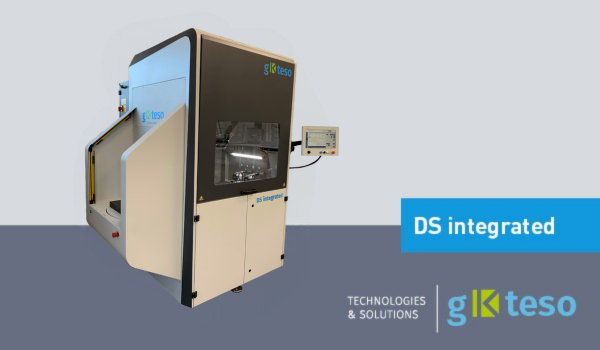
DS Integrated
The DS Integrated is designed for high quantities and changing geometries. It combines deburring, brushing, measuring, marking, and backside processing in a seamless process. Rotary or changeover tables minimize idle times and increase the cycle rate. With up to 16 stations and a working area of 500 x 500 x 300 millimeters, the system also processes complex small parts. Optional wet or dry processing is possible, complemented by automatic feeders for direct integration into existing lines.
| Merkmal | DS base | DS integrated |
|---|---|---|
| Arbeitsraum | 500 x 500 x 300 mm | 500 x 500 x 300 mm |
| Gesamtgröße | 1300 x 1800 x 2500 mm | 1800 x 1800 x 2500 mm |
| Maximalgeschwindigkeit | 1 m/s | 1 m/s |
| Wiederholgenauigkeit | 0,05 mm | 0,05 mm |
| Arbeitsstationen | bis zu 16 | bis zu 16 |
| Materialkompatibilität | Aluminium, Kunststoff, Verbundwerkst. | Metall (Stahl, Aluminium), Kunststoff |
| Werkstückgröße | bis zu 1000 mm Breite | bis zu 1500 mm Breite |
| Bearbeitungsverfahren | Trockenentgraten | Nass- und Trockenentgraten |
| Automatisierung | Manuelle Beladung, optional autom. | Vollautomatisch mit Beladesystemen |
